Discord Trading Rooms: Roles, Message History and Account Safety
Inspect who can publish or amend calls, what history a member can see and which permissions a community actually needs.
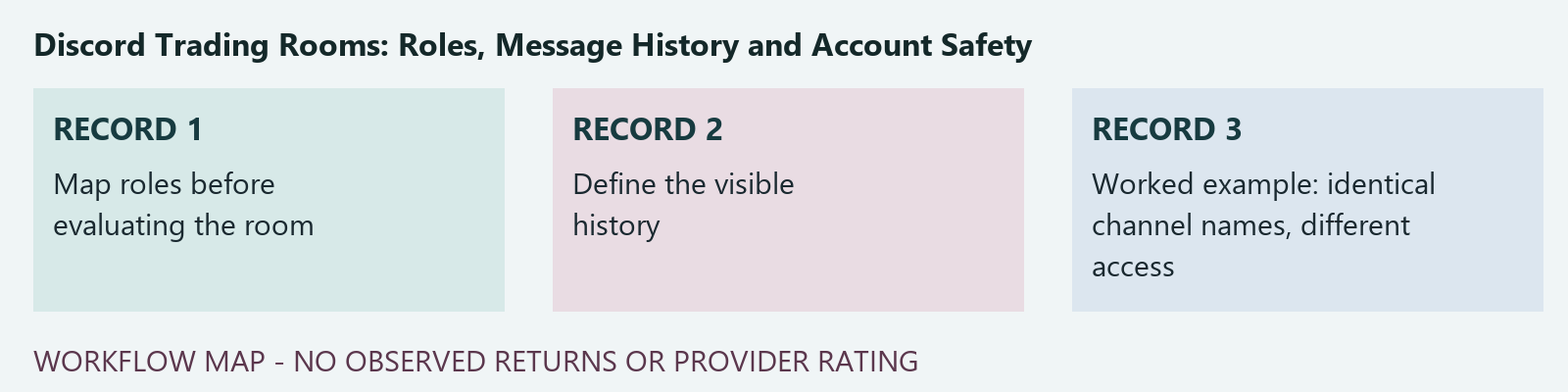
Map roles before evaluating the room
Identify operator, moderators, signal publishers, bots and ordinary members under the room's actual permissions. A message in a busy channel can come from different sources with different authority. Record how official calls are distinguished from discussion and whether role labels are stable. Discord's Safety Center provides platform context, not certification of a trading community. A large member number or frequent conversation does not establish genuine subscribers, complete signal records or investment performance.
Define the visible history
Check which channels a paid tier can read, whether earlier messages are available and how edits or deletions affect the review. Preserve source IDs and versions where access and privacy rules permit. Private channels or direct messages can leave gaps in an otherwise public-looking archive. Do not reconstruct a whole service population from one screenshot or a selection of highlighted wins. Keep the distinction between history you inspected and history the operator says exists; those evidence states should not collapse into a complete-archive claim.
Worked example: identical channel names, different access
Invent a room with an announcements channel visible to all members and an execution channel visible only to a paid role. A free observer can inspect announcements but cannot know whether the paid instructions contain the same levels or timing. A subscriber joining later may see a shorter history than an established member. The correct review describes those access boundaries instead of estimating unseen outcomes. This example is a permissions fixture, not a description of any named community or a paid-room test.
Keep bot permissions proportionate to the task
Identify what each integration requests and why. A community membership should not be treated as authority to obtain account passwords, recovery phrases or unrestricted funds access. Save the operator's documentation and distinguish optional tools from required ones. Delivery integration is another evidence class: webhook documentation can explain transport mechanics without proving reliable receipt, broker execution or correct order state. Do not assume a bot label means the trading logic, security or historical results were independently reviewed.
Join call versions with account events
An original instruction, moderator clarification, bot repost and provider cancellation can refer to one call. Use stable IDs and retain the authority for each material change. Keep expiry and instrument identity explicit. Receiving a chat message is not broker acceptance, and cancellation language does not prove an existing order was withdrawn. SEC order guidance supplies general execution context. Actual account evidence is still required to describe fills, partial exposure and unresolved requests after an amendment.
Evaluate the community for its own job
A useful room may provide education, support, discussion or an alert workflow. Describe which job was assessed and what remains untested. Save purchase, renewal, archive and contact terms for the exact tier, along with relevant commercial disclosures. Do not invent member satisfaction, interviews or user-review counts. This guide supplies a permissions and history protocol, not a measured community ranking. The blank worksheet lets a reader identify who can say what, what records are actually visible and which account actions remain outside the community's evidence.
Decision record
| Question | Record to retain | Decision boundary |
|---|---|---|
| Authority | Actual publisher roles and official-call definition | Discussion is not automatically an authorised signal |
| History | Tier, channel visibility and version retention | Partial access does not establish a full population |
| Permissions | Integration scope and stated necessity | Community access is not account authority |
| Execution | Original call and broker-side event trail | Message receipt cannot establish a fill |
Blank working record
The worksheet contains column headings only. Enter your own dated observations, keep absent evidence marked unknown, and do not treat the file as certification.
 Download worksheet (CSV)
Primary references
- Discord: Safety Center
- TradingView: webhook delivery and configuration
- SEC: order types and execution limitations
- FTC: endorsements and reviews
These documents support mechanisms and source definitions, not a tested trading result or a recommendation. Accessed 9 October 2026. The decision workflow and invented examples above are editorial exercises.
Keep reading
Publication methodology | Working glossary | Source and correction policy
A member view is not the whole server
The fictional access map has an open preview, a headline channel and separate original/update routes. The selected invented member can inspect some objects but not every linked requirement. That map concerns the declared observer, not a universal effective-permission calculation. No real handles or room IDs are published. A successful view of one channel cannot establish complete purchased-period history, while a current access gap cannot prove that an original was never posted. Keep both source population and observed view separate.
A completed missing-context result
The message packet retains all eight originals and shows exactly why two timely uncancelled received items lack context. One cannot open its linked original; another lacks a required attachment. The denominator is not changed after a price outcome because no outcomes are supplied. This makes the room exercise reproducible without redistributing private messages. The workbench can retain the role/history evidence state and the calculator can reproduce its counts, but neither establishes actual account safety or permission to execute a trading instruction.